The Mirror in the Loom: Kabir’s Ten Sharpest Truths
A weaver in fifteenth-century Varanasi reduced human self-deception to twenty-four syllables. Here is how Kabir’s sharpest couplets strip away spiritual pretense.
Almost everyone discovers prayer in an emergency room, during an audit, or on a turbulent flight. When comfort returns, the sky empties of urgency, and we forget the promises we made in the dark.
Six centuries ago, a weaver sat at his loom beside the burning ghats of Varanasi and saw this exact rhythm playing out around him. Kabir watched pilgrims bathe in the river, priests count rosary beads, and ascetics starve their bodies, all while nursing pettiness and greed in their hearts. He did not write to soothe or flatter. He wrote to strike a spark off stone. When he spoke the opening line of this collection—Dukh mein sumirin sab kare, sukh me kare na koy—he caught our most embarrassing human habit in a single net. Kabir does not offer theology; he hands us a mirror.
The Doha: Wisdom in Twenty-Four Beats
Kabir composed these verses in the fifteenth century in a vernacular blend of Braj Bhasha, Awadhi, Khari Boli, and Rajasthani, often called Sant Bhasha or Sadhukkadi—the rough, direct speech of wandering seekers.
The form here is the doha, an ancient Hindi rhymed couplet of twenty-four instants (matras) per line, typically broken into two balanced hemistichs of thirteen and eleven beats. A doha is built like an arch. The first line sets up a tension or an ordinary observation, and the second drops a heavy keystone into place. There is no chorus, no ambient padding, and no room for lazy words. Each couplet is an autonomous world that must prove its truth before its final syllable lands.
Reading Kabir: Ten Couplets on the Human Heart
These ten verses gather Kabir’s most enduring themes: the vanity of mechanical ritual, the true weight of a teacher, the radical grace of sufficiency, and the absolute priority of inward kindness over religious display.
The Fair-Weather Believer
दुख में सुमरिन सब करे , सुख मे करे न कोय। जो सुख मे सुमरिन करे , दुख काहे को होय॥
Dukh mein sumarin sab kare, sukh mein kare na koy. Jo sukh mein sumarin kare, dukh kahe ko hoy.
Everyone remembers the Divine in sorrow; no one remembers in joy. If one were to remember in joy, why would sorrow ever arise?
On the surface, this sounds like moral advice: remember God when life goes well, not just when things fall apart. But Kabir is rarely interested in simple scolding.
The deeper turn lies in the word sumirin, which means mindful presence, an unbroken inward awareness rather than an anxious plea for rescue. Kabir asks an unsettling psychological question. Why do we treat the sacred as an ambulance instead of the air we breathe? When life is sweet, we mistake comfort for invulnerability. If presence were woven into our everyday joy, the sudden shock of sorrow could never overturn us, because our peace was never dependent on circumstance in the first place.
The Wandering Bead and the Wandering Mind
माला फेरत जुग भया , फिरा न मन का फेर। कर का मन का डार दें , मन का मनका फेर॥
Mala ferat jug bhaya, phira na man ka fer. Kar ka man ka dhaar de, man ka manaka fer.
Ages passed turning the rosary beads, yet the mind's restlessness did not turn. Drop the bead from your hand; turn the bead of the mind.
This couplet contains one of the most celebrated puns in Indian literature, pivoting on the phrase man ka. In Hindi, kar ka man ka means the wooden or stone bead held in the hand, while man ka manka means the bead of the inner mind.
Kabir skewers ritual posture. You can sit with eyes closed, rolling beads through your fingers for decades, while your thoughts bargain in the marketplace or nurse an old grudge. The fingers keep moving like clockwork, perfectly pious, entirely absent. Kabir’s instruction is blunt: drop the external counter. If the inward attention does not revolve toward truth, your fingers are merely playing with pebbles.
The Teacher Before the Divine
गुरु गोविन्द दोनों खड़े , काके लागूं पाँय। बलिहारी गुरु आपनो , गोविंद दियो बताय॥
Guru Govinda dono khade, kake laagun paanay. Balihari Guru aapno, Govinda diyo bataay.
The Guru and God both stand before me; whose feet should I touch first? I surrender to you, my Guru, who showed me where God is.
A classic Kabir paradox. Confronted by both the ultimate source of existence (Govind) and the mortal human being who taught him (the Guru), the seeker freezes in etiquette. Who takes precedence?
Kabir chooses the human guide without hesitation. Without the teacher, Govind remains an abstract rumour, a blank horizon. It was the teacher’s patient, flawed, human voice that opened the student's eyes to see the Divine in the first place. Kabir honors the bridge over the river it helped him cross. In a culture obsessed with cosmic abstractions, Kabir returns the debt of love to human hands.
Transformed in a Single Heartbeat
बलिहारी गुरु आपनो , घड़ी-घड़ी सौ सौ बार। मानुष से देवत किया करत न लागी बार॥
Balihari guru aapno, ghadi-ghadi sau sau baar.
Manush se devat kiya karat na lagi baar.
I offer myself to my teacher, every moment, a hundred times over. Who turned a mere mortal into divine consciousness, and took no time at all.
Following the third doha, this verse deepens the debt. Kabir marvels at the speed of genuine awakening. Transforming an ordinary, anxious human being into someone who carries divine clarity does not take lifetimes of contortion; it happens the moment false perception shatters. The teacher’s stroke is instantaneous, though preparing oneself to receive it may take years.
The Waterwheel of Empty Prayer
कबिरा माला मनहि की , और संसारी भीख। माला फेरे हरि मिले , गले रहट के देख॥
Kabiira mālā manahi kī, aur saṃsārī bhīkh. Mālā phere Hari mile, gale rahaṭ ke dekh.
Kabir says: the true rosary belongs to the mind, all else is worldly begging. If turning beads brought God, look at the waterwheel tied with pots around its neck.
Kabir brings us straight into the rural landscape. A rahat is a traditional Persian waterwheel, fitted with earthen pots strung around a wooden wheel that dips endlessly into the well and empties itself out. If looping beads around your neck or rotating strings through your fingers could summon truth, then the waterwheel—which wears a necklace of pots and turns all day long—would be the greatest saint in the village. Kabir’s humour is razor-sharp: repetition without conscious love is just mechanical irrigation.
The Deaf Sky
सुख मे सुमिरन ना किया , दु:ख में किया याद। कह कबीर ता दास की , कौन सुने फरियाद॥
Sukh me sumiran na kiya, dukkh mein kiya yaad. Kah Kabir ta Das ki, kaun sune fariyaad.
You did not remember in times of joy, but only cried out in grief. Kabir asks: who will listen to the desperate petition of such a servant?
This echoes the first doha but with a colder sting. The word faryad carries the weight of a legal petition, an emergency appeal shouted at the court gates. Kabir reminds us of the insolence of transactional devotion. When someone ignores a companion through every feast and calls them only to pay the bill, the relationship is a sham. A heart that remembers only when cornered cannot be surprised when its frantic cries echo back from an empty room.
The Grace of Enough
साईं इतना दीजिये , जा मे कुटुम समाय। मैं भी भूखा न रहूँ , साधु ना भूखा जाय॥
Sai, itna dijiye, ja mein kutum samay. Main bhi bhookha na rahoon, sadhu na bhookha jaay.
Lord, give me only this much, enough to sustain my household: that I may not starve, and that no seeker leaves my door hungry.
Among all of Kabir's verses, this prayer is perhaps the most tender. In an age where religious figures often demanded immense patronage or practiced extreme, exhibitionist asceticism, Kabir asks for simple sufficiency.
Notice the boundary he draws. He does not ask for luxury, but he refuses romanticized destitution. He wants his family fed, and he wants an extra handful of grain for the stranger who walks up to his threshold. To Kabir, true wealth is not an overflowing vault; it is the capacity to be hospitable without anxiety.
The Urgent Plunder
लूट सके तो लूट ले , राम नाम की लूट। पाछे फिरे पछताओगे , प्राण जाहिं जब छूट॥
Loot sake to loot le, Ram naam ki loot. Paache phire pachtaoge, praan jaahin jab chhoot.
Plunder if you can plunder, the treasury of the Divine Name is open to loot. Later you will grieve and regret, when the breath slips away.
Kabir borrows the rough language of highwaymen and bazaars. Ram naam here does not refer to a sectarian deity; for Kabir, Ram is the formless, unconditioned reality present in all life. He treats awakening not as a dull obligation, but as an open vault during a riot of grace. The urgency is visceral: breath is a finite currency. Every exhalation is a coin spent, and once the vault door swings shut, no amount of weeping can buy back a lost hour.
The Sword and the Sheath
जाति न पूछो साधु की , पूछि लीजिए ज्ञान। मोल करो तलवार का , पड़ा रहन दो म्यान॥
Jāti na pūcho sādhu kī, pūchi lījie jñān. Mol karo talvār kā, paṛā rahan do myān.
Do not ask the caste of a wise seeker; ask instead of their wisdom. Appraise the value of the steel blade; leave the scabbard lying where it is.
In fifteenth-century India, caste determined where you could walk, whose water you could touch, and which texts you were permitted to hear. Kabir, working at his loom on the social margins, slices through this hierarchy with an artisan’s practical eye.
A warrior in battle survives because of the sharpness and balance of the steel blade, not the velvet or gold wire wrapped around the sheath. The body, lineage, and social rank are merely the scabbard; insight is the cutting edge. To honor a person’s birth while ignoring their character is to purchase an empty scabbard and throw the sword into the mud.
Where the Divine Takes Up Residence
जहाँ दया तहाँ धर्म है , जहाँ लोभ तहाँ पाप। जहाँ क्रोध तहाँ पाप है , जहाँ क्षमा तहाँ आप॥
Where there is compassion, there is righteousness; where there is greed, there is sin. Where there is wrath, there is ruin; where there is forgiveness, there You dwell.
Kabir closes by sweeping away theological complexity. Religion is not where doctrine lives; it lives where daya—mercy and active kindness—is practiced. Crucially, in the final clause, he states that the Divine does not reside in temples or mosques, but wherever kshama (forgiveness) makes room. God is not an entity standing apart from conduct; the Divine is the quality of an unburdened, forgiving heart.
Words to Know
सुमरिन (sumirin)
Remembrance; meditative mindfulness of the Divine rather than mechanical recitation.
मन का / मनका (man ka / manka)
A pun meaning both 'of the mind' (man kā) and 'a rosary bead' (mankā).
बलिहारी (balihārī)
Complete surrender or offering of oneself in deep reverence.
रहट (rahat)
A Persian waterwheel rigged with pots, used to lift water from a well.
कुटुम (kutum)
Household or extended family (from the Sanskrit kutumba).
साधु (sādhu)
A true seeker or virtuous person, beyond sectarian clothing or monastic titles.
म्यान (myān)
The scabbard or sheath holding a sword; metaphorically, the mortal body or outer social identity.
आप (āp)
Here, an honorific referring to the Divine Self residing within.
The Loom Beside the Burning Ghats
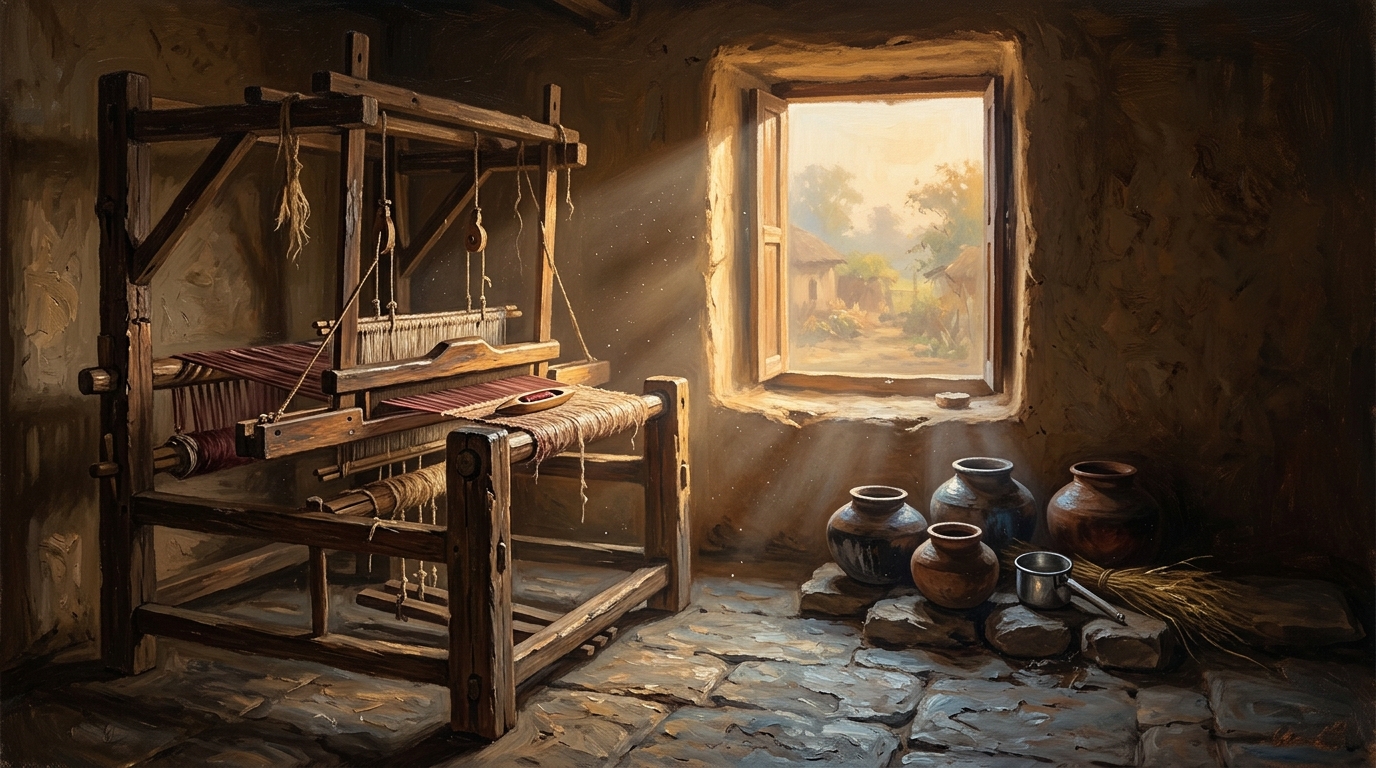
Kabir lived and died in fifteenth-century Varanasi, belonging to the Julaha community of Muslim weavers who occupied an uneasy space on the fringes of orthodox society. He worked with his hands every day. His metaphors did not come from royal courts or secluded monasteries; they came from the clacking wooden shuttle, the warp and weft of thread, the market stall, and the water pots rattling down the street.
He refused to be claimed by either orthodox Hinduism or institutional Islam. When pandits demanded his caste lineage, he pointed to his loom. When clerics insisted on external prayer postures, he laughed at their pretense. This independence gave his voice its peculiar, fearless clarity. Kabir spoke as an outsider who had nothing to lose and no patron to please, measuring every philosophy by how it stood up against the daily realities of work, hunger, and grief.
Echoes Across Time
Kabir’s insistence on sufficiency over luxury in the seventh doha directly mirrors the Stoic reflections of Seneca, who wrote that true wealth consists not in having great possessions, but in having few wants. When Kabir asks only for enough grain to feed his household and share with the traveler, he outlines the exact middle way that philosophers across civilizations have fought to protect against consumerist frenzy.
His dismissive comparison of prayer beads to a waterwheel in the fifth doha finds an uncanny sister in Jalaluddin Rumi’s writings, where Rumi mocks those who polish the lamp-glass while leaving the wick unlit. Both Kabir and Rumi saw through spiritual consumerism: the tragic, comedic habit of collecting religious accessories while remaining entirely untouched by grace.
Why Kabir Still Strikes a Nerve
We live in an age of curated righteousness. Social feeds allow us to perform virtue, parade our affiliations, and count the modern equivalents of rosary beads—followers, metrics, and outward gestures of belonging. Kabir walks straight through this digital temple, overturns the stalls, and asks what remains when the screens go dark.
His verses strip away spiritual self-flattery. He does not ask what books you have read, which heritage you claim, or what ceremonies you attend. He asks a much simpler, terrifying question: when joy arrived, did you remember? When the stranger knocked, did you have a handful of bread to give?
If your inner thoughts were written across your forehead today, would you still pick up your beads?
The scabbard decays into dust; only the steel edge cuts through the dark.
Explore in Sukhan AI
This article is linked to poems, poets, and couplets from the Sukhan AI archive.
What is the core meaning of Dukh Mein Sumiran Sab Kare?
It means that human beings instinctively pray during crisis or suffering, but abandon inward mindfulness when life is pleasant. Kabir observes that if one sustained grateful presence during times of comfort, existential grief would lose its power to overwhelm us.
What is the famous wordplay in Kabir's doha Mala Ferat Jug Bhaya?
Kabir uses the pun 'man ka'. 'Kar ka man ka' means the physical rosary bead rolled between the fingers, while 'man ka manka' refers to the bead of the inner mind. Turning the former without stilling the latter is an empty ritual.
Why does Kabir bow to the Guru before God in Guru Govind Dono Khade?
Kabir bows to the teacher first because without the human guide's instruction, the seeker would never have recognized the presence of the Divine. The teacher is the indispensable path that makes the destination visible.
What dialect did Kabir use to compose his dohas?
Kabir composed his verses in Sant Bhasha (or Sadhukkadi), a direct, colloquial blend of Braj Bhasha, Awadhi, Khari Boli, and Rajasthani, designed to be understood by ordinary working people rather than elite scholars.